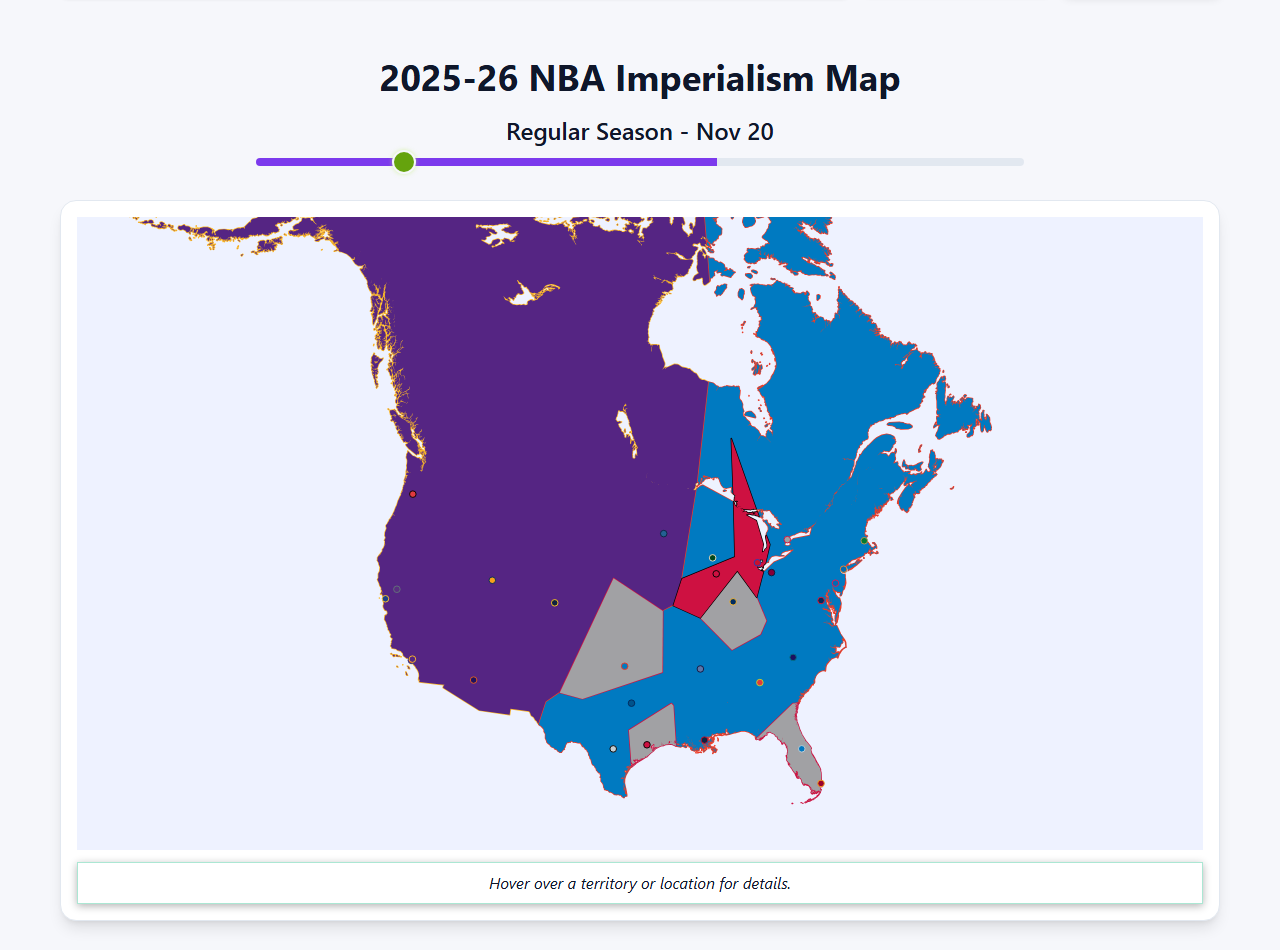
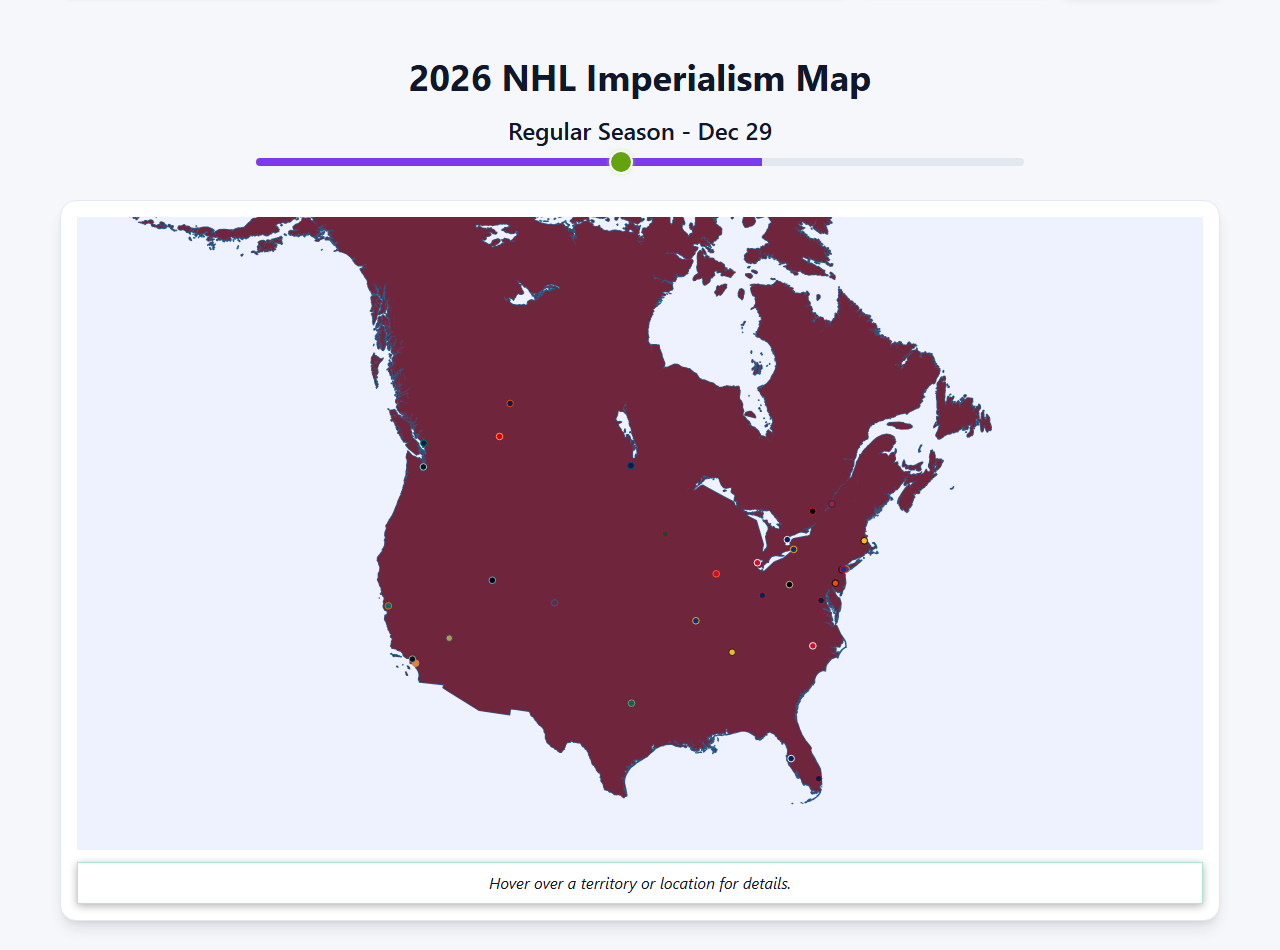
How Imperialism Map Works
The rules are simple, but the results can be dramatic.
The Basic Rules
TL;DR: Each team starts with their home territory. Winners take all the loser's land. Last team standing owns the country.
-
Initial Territory Distribution
Before a single game is played, every team owns the land closest to its home stadium or arena. That produces a Voronoi diagram: every point on the map belongs to whichever team is nearest. It is each team's natural territory, drawn from where it actually plays rather than from city or state lines.
-
Conquest Through Victory
When two teams play each other, the winner conquers all of the loser's territory. It doesn't matter if it's a blowout or a last-second field goal. Winner takes all. There's no splitting territory or partial conquest.
-
Accumulation of Territory
Territory compounds. Beating an opponent who has already conquered half the country hands you half the country, so a single win late in the season can be worth more than a dozen wins early. Lose once and you are back to nothing, no matter how much you had built.
A Worked Example
Here's how a typical NFL season might start:
- Week 1: The Bears beat the Packers. Chicago now controls its own territory plus all of Green Bay's land, and most of Wisconsin changes hands overnight. The Packers vanish from the map.
- Week 2: The Lions beat the Bears. Detroit inherits everything Chicago held: its original territory, plus Wisconsin. Two wins by two different teams, and the Lions own a three-team empire they only fought one game for.
- Week 3: The Packers beat the Vikings. Green Bay was eliminated, but eliminated teams keep playing, and a win against a team that still holds land brings them roaring back. The Packers return, now holding Minnesota instead of Wisconsin.
Chain enough of these together and a single late-season upset can redraw half the country. That's the fun of it: pick any season on the home page and drag the time slider to watch an empire rise or fall. Or run the rules yourself in the editable imperialism map maker, where you decide who wins every game.
Strategic Implications
Winner-takes-all makes some games matter far more than the standings suggest:
- Strength of Schedule Matters: Beating a team that's already accumulated lots of territory is more valuable than beating a team that's already lost theirs.
- Timing is Everything: An early-season loss can mean missing out on huge territorial gains later.
- Upsets Have Consequences: When a small-market team upsets a territorial empire, they suddenly become a major power on the map.
- Transitive Property: If Team A beats Team B, and Team B beat Team C, then Team A owns what used to be Team C's territory, even if they never play each other.
Edge Cases & Special Situations
Ties
Nobody conquers anybody. A tie leaves both teams holding exactly what they had before kickoff.
Neutral Site Games
Bowl games, playoffs, and neutral site games work the same way: winner takes all the loser's territory, regardless of where the game is played.
Beating a Landless Team
If the losing team has already been wiped off the map, nothing happens, because there's no territory to take. But the reverse is the comeback path: a landless team that wins takes everything its opponent holds and rejoins the map.
Frequently Asked Questions
What is a sports imperialism map?
A sports imperialism map shows every team’s territory on a real map and lets the results of each game redraw the borders. Each team starts with the land closest to its home venue; when a team wins, it takes all of the loser’s territory, and the last team standing controls the whole map.
How do teams gain territory?
By winning games. When two teams play, the winner conquers every territory the loser controls, whether that’s one home region or half the country. Margin of victory doesn’t matter.
What happens when a team loses?
The losing team hands over all of its territory and disappears from the map. There’s no partial loss: one defeat wipes out an entire empire.
Can an eliminated team come back?
Yes. A team with no territory keeps playing its scheduled games, and if it beats a team that still holds land, it takes everything that team owns and returns to the map.
What happens in a tie?
Nothing changes. If a game ends in a tie, no territory changes hands and both teams keep what they had.
Do playoff and neutral-site games count?
Yes. Every completed game counts the same. Bowl games, playoffs, and neutral-site matchups all transfer the loser’s full territory to the winner, no matter where they’re played.
What is a Voronoi diagram and why is it used?
A Voronoi diagram divides the map so that every point belongs to the nearest team’s home venue. It’s how the starting territories are drawn: each team begins the season controlling the land closer to its stadium or arena than to anyone else’s.
Can I make my own imperialism map?
Yes. The editable imperialism map maker starts you from any league and lets you decide every matchup yourself, either by picking the winner or by spinning the arrow to leave it to chance. The same conquest rules apply, so the map redraws as you go and you can share the result when you are done.
Which leagues and seasons are covered?
Interactive maps cover the NFL, college football, NBA, NHL, MLB and more, including historical seasons. MLB goes back to 1871. Maps update automatically while a season is live.
How to Read the Map
Colors
Each territory is colored with the controlling team's primary color. We use official team colors extracted from their branding guidelines.
Boundaries
The Voronoi diagram creates natural-looking boundaries based on geographic proximity to stadiums. These don't follow state or county lines, they are purely based on distance.
Time Slider
Use the slider at the top to travel through the season. Leagues that play weekly (like football) step week by week; leagues with daily games (basketball, hockey, baseball) step day by day.
Territory Table
Below the map, see exactly how many territories each remaining team controls, sorted by territorial dominance.
Curious how this project started? Read the story on the About page.
Popular Sports Territory Maps